Freight margin leakage in manual quoting
Freight margin leakage rarely starts with one obvious mistake. It usually starts with small quoting failures that repeat across shipments.
An old carrier rate gets used. A fuel surcharge is missed. A markup is changed manually. A carrier update sits in someone's inbox. A quote goes out before the latest conditions are checked.
Each issue looks minor on its own. Across enough quotes, it becomes a real commercial problem.
This is why manual quoting is not just an operational headache. It is a margin risk.
Where manual quoting leaks margin
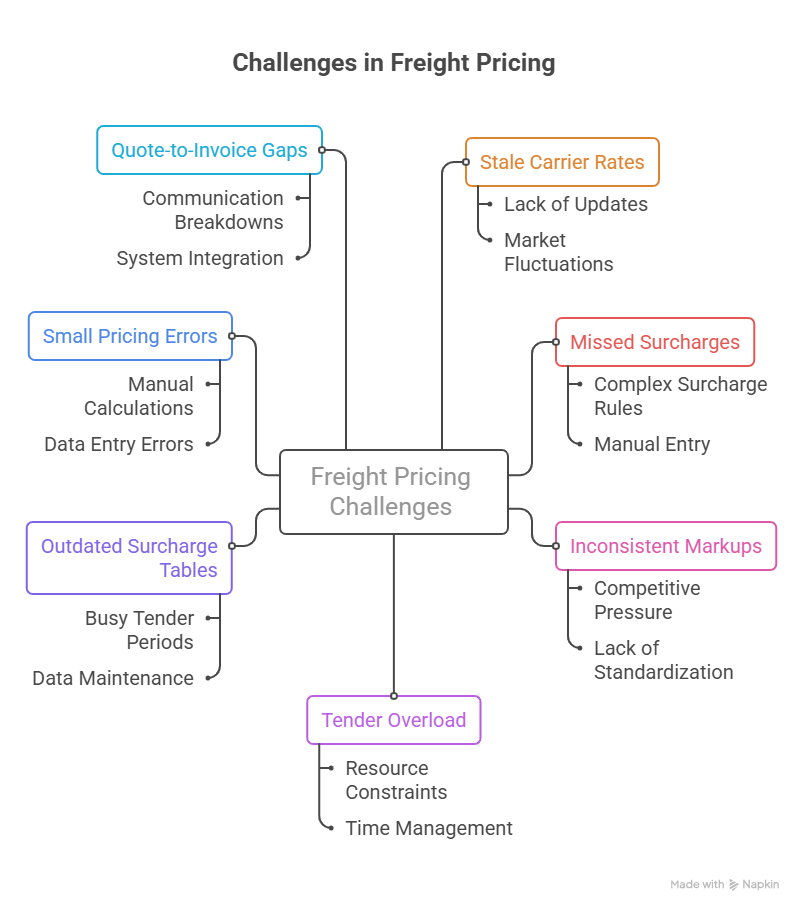
1. Stale carrier rates
Freight rates move. Even when base rates are contracted, surcharges and validity periods change.
If a team is quoting from spreadsheets or local files, it is easy for the wrong version to remain in use. The quote may look right because the formula works. The source rate is the problem.
2. Missed surcharges
Fuel levies, BAF, CAF, terminal handling, congestion, accessorials, remote area charges, minimum charges and carrier-specific conditions often sit outside the main rate table.
If those charges rely on someone remembering to check the right sheet, email or footnote, margin protection becomes dependent on individual discipline.
3. Inconsistent markups
Manual quoting often creates inconsistent pricing behaviour.
One salesperson applies a standard margin. Another discounts to win the work. A pricing coordinator adjusts a number because the customer is important. None of this is necessarily wrong, but it needs visibility.
Without controls, the business cannot tell the difference between a deliberate commercial decision and an accidental margin loss. The financial outcome can look identical. The distinction is whether the decision was visible, traceable and intentional — or whether it just happened.
4. Tender overload
Tenders expose weak pricing workflows.
A team may handle ten quotes a day with manual processes. But when a tender requires dozens or hundreds of lanes, spreadsheet logic gets stretched. Errors multiply because the team is under time pressure.
Example: A freight forwarder receives updated road freight rates from three carriers.
One carrier updates fuel surcharges weekly. Another changes validity dates mid-month. A third sends rates as a scanned PDF attachment.
During a busy tender week, an old surcharge table remains in use for several customer quotes.
The quote is accepted, but the invoiced carrier cost is higher than expected.
Individually, the difference looks small. Across multiple shipments, the margin loss becomes significant.
The deeper risk is not the error itself: it is the commitment it creates. A tender won on stale rates is a contract priced on costs that may already be wrong. At tender volumes, a small per-shipment discrepancy compounds across every shipment in the contract period before anyone reviews the margin outcome.
5. Small errors compound quickly
A missed surcharge on one quote may not look serious.
But if a team under-recovers $80 on 40 shipments in a month, that is $3,200 of margin leakage before anyone has reviewed invoice variance.
The numbers do not need to be dramatic to matter. They just need to repeat.
A missed surcharge on one shipment is noise. The same missed surcharge applied consistently across a carrier, a lane or a customer account is a pricing rule that is silently working against the business.
6. Quote-to-invoice gaps
Invoice variance (the difference between the carrier cost assumed at quoting and the cost actually billed) is where quoting errors become visible. But by the time variance appears on an invoice, the quote has already been sent, accepted and acted on.
The margin issue does not end when the quote is sent.
If the carrier invoice does not match the expected cost, the business needs to know why. Was the quote wrong? Did the carrier bill incorrectly? Was a surcharge missed? Did shipment conditions change?
Invoice audit is useful, but it is stronger when connected back to the rate and quote data.
Why is freight margin leakage hard to detect?
The reason these failures persist is that manual quoting often feels normal.
The pricing manager knows which carrier file to trust. The senior sales rep knows which surcharges to check. Operations knows which invoices are usually wrong.
That knowledge keeps the business running, but it also creates dependency on individuals.
When volume grows, people leave or tender pressure rises, the workaround becomes the bottleneck.
How to reduce margin leakage risk
Centralise active rates
Pricing teams need one controlled source for active carrier rates. Old files should not continue floating around as live pricing sources in inboxes, desktops or copied spreadsheets.
Track validity dates
Every rate should have a start date, end date and review status. If a rate is expired, pending approval or superseded, the quoting workflow should make that obvious.
Make surcharges visible
Surcharge logic should be visible, reviewable and connected to the quote workflow. Fuel, terminal, accessorial and carrier-specific charges should not depend on memory.
Standardise markup rules
Commercial flexibility is fine. Hidden inconsistency is not. Pricing rules should allow exceptions, but exceptions should be visible and explainable.
Create a quote audit trail
The business should be able to trace which buy rate, surcharge, markup and approval created a customer quote. Without that audit trail, invoice disputes and margin reviews become guesswork.
Connect quote data to invoice review
Invoice audit becomes more useful when it links back to the original quote assumptions. If the expected cost and actual carrier invoice differ, the team needs to know whether the issue was quoting, billing or shipment variation.
Where Fretara fits
Fretara helps reduce the risk of margin leakage by turning messy carrier rates into controlled pricing data and supporting more consistent quote workflows.
Fretara helps freight forwarding teams centralise carrier rate management, structure surcharge logic and prepare quotes from controlled pricing data instead of disconnected spreadsheets.
Teams can review extracted rates, track validity periods, apply markup rules consistently and maintain a quote audit trail connected back to source pricing files.
This helps reduce operational pricing risk while improving quote preparation speed during day-to-day quoting and tender workflows.